ReflectionsTuesday airs each week on GospelBellsRadio.com, where Pastor Ayo Agunloye reflects on current themes from Your Potter’s House, the daily devotional he writes and publishes. This report is an edited summary of the broadcast, faithful to the teaching as delivered and prepared so that listeners and readers may revisit it, study it, and pass it on. Added Scripture references are provided to aid personal study.
Returning to the air after a season’s break, Pastor Ayo Agunloye opens a new month and a new series on ReflectionsTuesday. Still within the year’s Your Potter’s House journey of cultivating a heart after God’s own heart, September turns to what he calls the last-born attitude—and today’s introductory message, drawn from the September 1 devotional, is titled “The Heart That Leans.”
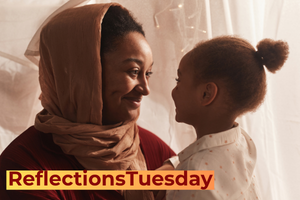
The picture is a familiar one from any home:
A small child leans into a parent’s arms without calculation—never first weighing whether the arms are strong enough to hold him. He simply trusts, and leans.
That posture, the pastor argues, is exactly the one God is looking for in us.
🎧 Listen to the Full Episode Below
This is a warm, foundational message opening the month’s theme, with a rich closing conversation on how grown, hardened adults can relearn childlike trust. Worth a slow, unhurried listen.
🍼 The Last-Born Attitude
Everyone recognises the last-born in a family—fond, clinging, completely at home in a parent’s affection. A mother will warn even the older children, “don’t touch my child,” not because she loves the others less, but because the youngest’s very dependence and vulnerability draw a compelling tenderness.
The pastor is quick to make the crucial clarification: this is not favouritism on God’s part.
God does not practise favouritism—He responds to the posture of the heart. To the froward He shows Himself froward; to the faithful, faithful (Psalm 18:25–26).
The last-born throws himself completely on his parents’ love, unworried about earning it. That, and not age or rank, is the attitude the month will explore—the heart that relates to God not by anxious rule-keeping but by unguarded, trusting nearness.
🕊️ John, the Disciple Who Leaned
The clearest New Testament model is John, “the disciple whom Jesus loved.” The youngest of the Twelve, he behaved like a last-born—leaning his head on Jesus at the table, so that when the betrayer was in question, Peter had to beckon himto ask the Master (John 13:23–25).
That intimacy was not lost on Jesus. It was John who remained at the cross when the others had fled, and to John that Jesus entrusted His own mother—“Behold thy mother” (John 19:26–27). It was John, too, who was among the three at the Mount of Transfiguration and in Gethsemane.
It is the one who leans closest whom the Lord can trust with the most intimate assignment.
Not because the others were unloved—but because one disciple carried the heart that leans.
👑 Not Age, but Posture: Joseph
Lest anyone think the lesson is about birth order, the pastor points to Joseph, who was not the last-born (Benjamin was) yet plainly carried the attitude. He “shared his dreams openly with his father” (Genesis 37:3)—no scheming, no managing how he was seen—and that childlike openness drew Jacob’s affection and, in time, positioned him for everything God had prepared.
Benjamin, by contrast, was carefully protected but never shown displaying the same open, leaning intimacy.
It is not about age. It is about the openness that does not compete, does not manipulate, and does not filter what it brings to the Father.
📖 The Text: Matthew 18:1–4
When the disciples asked “Who is the greatest in the kingdom of heaven?”, Jesus set a little child among them: “Except ye be converted, and become as little children, ye shall not enter… Whosoever therefore shall humble himself as this little child, the same is greatest” (Matthew 18:1–4).
The greatest, the pastor stresses, is the one who is childlike—not childish—in relating to God.
🧒 The Heart That Leans
The devotional itself turns on a wonderfully ordinary illustration. A child brings home the school report—tucked inside, the letter listing next term’s fees, uniform, and books. He hands it over, changes out of his uniform, asks for his food, and goes off to play. How the bill will be met is simply no longer his concern.
That is the childlike trust Jesus asks of us—casting our cares on Him and leaving them there (1 Peter 5:7), taking no thought for what we will eat or wear (Matthew 6:25–34).
The trouble, the pastor observes, is that we have grown up—and quietly taken over God’s job of worrying. We multiply our own burdens “simply because we are no longer children.” And a new month especially tempts us to lean harder on our own strategies, when the safest place to begin again is exactly where Joseph began: in honest, childlike dependence.
Lean into Jesus today as a child leans—without first proving yourself worthy of His arms. He is already holding you.
😢 Even Jesus Leaned
Anticipating the objection that such openness is immature, the pastor points to Christ Himself, who “offered up prayers and supplications with strong crying and tears” (Hebrews 5:7). Jesus had real emotions—fear, anger—yet all of them godly. Maturity, he insists, does not mean tearlessness.
The Lord is not asking us to be clever before Him. He is asking us to be children—open, teachable, unguarded.
So much of our striving, he suggests, grows out of a quiet fear that if we lean fully on God, He may not come through. And so we hedge, plan around Him, and keep a Plan B, C, and D in reserve—an insurance policy against the Father that only pushes us farther from His affection.
🔄 Rebuilding a Childlike Heart
In a thoughtful closing exchange, the presenter raises the honest, practical question: for adults hardened by the experiences of life, how does one rebuild a childlike trust that once came naturally? He recalls the psalmist who “calmed and quieted” his soul “like a weaned child with its mother” (Psalm 131:2).
The pastor’s answer is candid. We unconsciously outgrew our dependence once we could think and act on our own—and familiarity bred contempt, not with God, but with the methods we came to rely on. His caution is memorable: God once told him privately to use ordinary toothpaste for an ailment, and it worked—but it would be folly to systematise that into a formula and prescribe toothpaste to everyone. God wants to guide us freshly, keeping us always asking, always leaning.
He and the presenter dwell on Dolly Parton’s “Coat of Many Colors”—the child so proud of the coat her mother made that she was unmoved by the mockery of better-dressed peers, precisely because her mother had called it the best. It becomes a picture of receiving and prizing whatever the Father gives, however the world rates it.
Whatever God has given you, wear it proudly as His child—and lean on Him without insisting on your own will, saying with Jesus, “not my will, but Thine be done.”
🌟 Final Reflection
“The Heart That Leans” sets a gentle but searching tone for the month ahead. After a year of cultivating a heart after God’s own, the series turns to the manner of our nearness—asking whether we relate to God as anxious, self-managing adults, or as beloved children who simply lean.
The invitation is not to become naïve, but to become childlike again: to hand over the weight we were never meant to carry, to stop proving and start trusting, and to let the Father hold what we have been holding alone.
The greatest in the kingdom is not the cleverest or the most self-sufficient—but the one whose heart still leans.
The episode closes in prayer:
“Lord, we have seen that You desire us to be like children in Your hands—open, teachable, trusting Your love and Your power. Help our hearts to depend completely on You, without deceiving ourselves, that we may enjoy more of You and Your affection this month. In Jesus’ name. Amen.”
This is a message to lean into, not merely admire.
Listen again. Loosen your grip. And ask God for the grace to hand Him what you have been carrying alone.