– Olufemi Oguntokun
They say that in country music, every song tells a story. If your heart has ears, the story draws you in. The song ends, and the characters stay. You catch yourself filling in the blanks. Sometimes you see yourself in one of them. Sometimes you see someone you know.
Sometimes you cry with the broken-hearted (I Will Always Love You). Sometimes you want to meet the hero and high-five him (You’re My Best Friend). Sometimes you start keeping an eye out for the villain (Jolene). Sometimes you ache for a place or a person now beyond your reach (Green, Green Grass of Home). Some stories trouble you (I Hope You’re Never Happy). Some are downright silly (Why’d You Come In Here Lookin’ Like That). Many are simply sad (Every Time Two Fools Collide).
But some carry profound wisdom. Coat of Many Colors is one of those.
Dolly Parton was twenty-three when she wrote it, in 1969. She had been singing since she was ten, and she was already a name in music circles. The memories came to her on a tour bus. She reached for the nearest paper — the back of a dry cleaner’s receipt — and wrote the lyrics there. When the song became a hit, someone framed the receipt.
Dolly Parton died on 25 August 2026, at eighty. That is fifty-seven years after the bus ride. The song she scribbled that day tells of a childhood of well-documented poverty, and of how happy that childhood was. I have been listening to it again this week. Three minutes long. A lifetime of wisdom in it.
And it begins with a box.
“… a box of rags that someone gave us.”
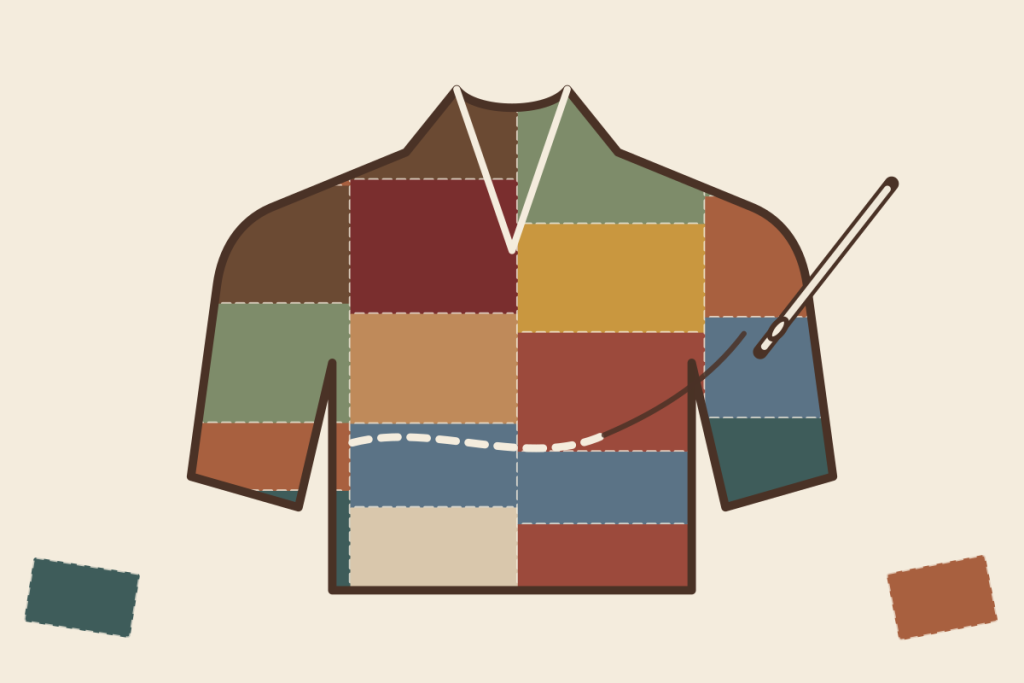
Someone gave the Partons a box of rags. Yes, you read that right. Rags. The song mentions it in passing and moves on. Why rags? We are not told. But those rags set the whole miracle in motion.
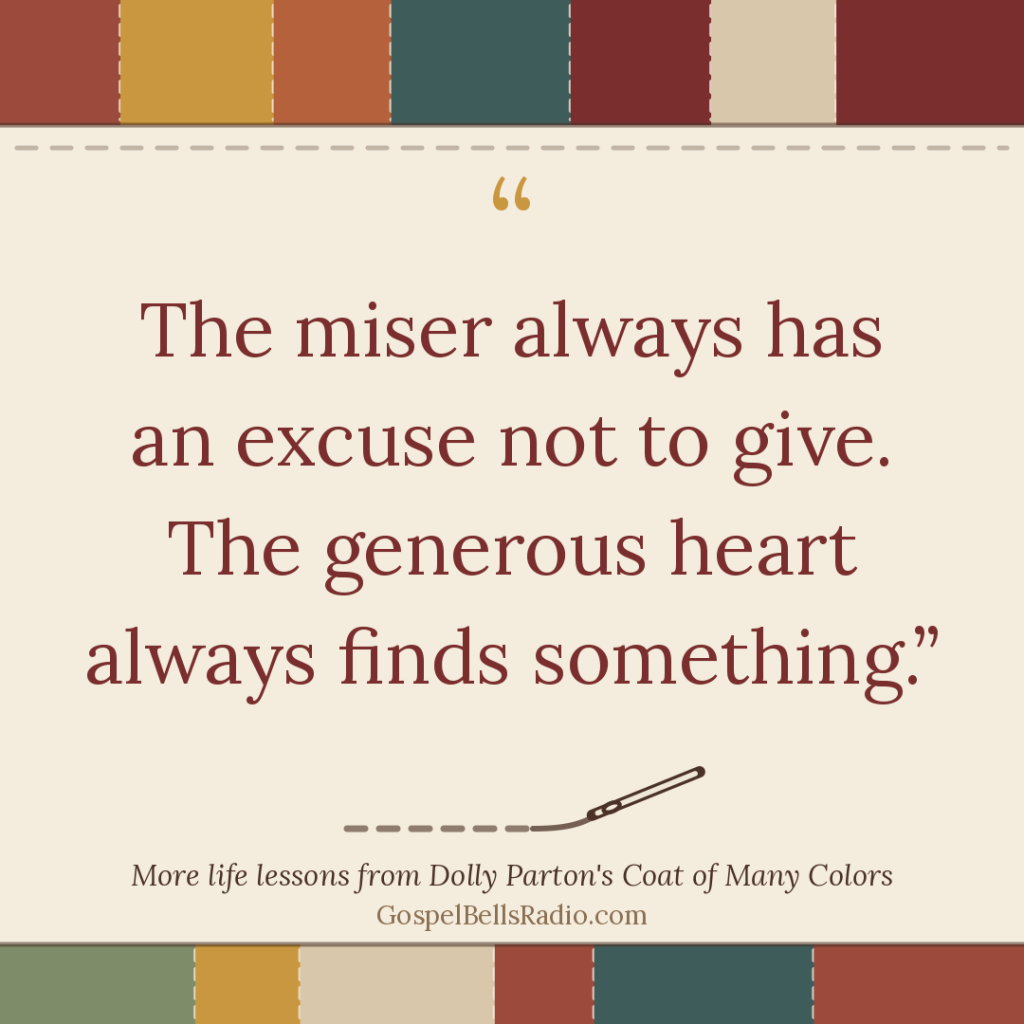
The miser always has an excuse not to give. The generous heart always finds something. Have you noticed that? When you truly want to give, something is always there.
Perhaps you have held back because what you had seemed too small. That anonymous friend of the Partons did not. Give whenever you see a need. Find something to give, however little. The God of miracles delights in the widow’s mite. He delights in multiplying small gifts, especially when small is all there is.
“… and how my momma put the rags to use.”
Mama Parton could not dress her children in rich robes. She did not sink into despair over it either.
If you do not yet have what you want, begin by wanting what you have. Want it while you wait. Want it while you pray. That one shift in attitude changes everything, because it lets you see what your little is actually able to do.
Unbelief asks a miserable question: “What can I possibly do with this?” “What am I expected to make of rags?” Faith asks a better one: “What can I make out of what I’ve got?”
Mama Parton put the rags to use. What do you do when rags are all life has thrown your way?
“… as she sewed, she told a story …”
Dolly needed a coat. The cold of the fall was coming. But her mother was doing something larger than sewing.
She was not hissing at her fate. She was not bemoaning her husband’s poverty. She sewed, and she told a story, and she prayed over her daughter, and she wished her luck and happiness.
No one has ever doubted Dolly Parton’s sense of her own worth. It had nothing whatever to do with the fabulous wealth she later made. It was stitched in early.
Wise parents set their children off right. Not only by supplying the coat. Not only by meeting the pressing need. They teach, by example, how to engage the vicissitudes of life with a positive attitude.
“… a story from the Bible, she had read …”
Here is Deuteronomy 6:7 at work in a poor cabin: “You shall teach them diligently to your children and shall speak of them when you sit in your house and when you walk on the road and when you lie down and when you get up.”
The most important subject is the one most neglected in our homes. A child can be well provided for. A child can be trained in the most elite school. But send that child out not knowing God and His precepts for life, and you have sent him out at a disadvantage. At the mercy of a godless culture. Before a rampaging spiritual enemy.
What is the last Bible story you shared with your children?
“… about a coat of many colors Joseph wore …”
This is where Mama Parton took advantage of little Dolly’s innocence.
Yes, Joseph’s father made him a coat of many colors. But Joseph’s was a rich coat, cut from the finest materials. That was why his brothers burned with envy.
Dolly’s coat had many colors for a different reason altogether. It was sewn from rags, from scraps of different discarded clothes. Nobody designed it that way. And Mama Parton used Joseph’s story anyway, to send her daughter out wearing hers with pride and joy.
A ‘white lie’?
No.
Her point was never the quality of Joseph’s coat. Her point was the giver, and what moved the giver: love.
Every gift takes its value from the love in the heart that gives it. Without love, the priceless diamond means nothing to the one who receives it. Given with love, a box of sweets becomes a cherished treasure.
Even God will take nothing from a cold heart. “Your offerings are an abomination to Me,” He told the hypocrites of Judah. Of the poor widow He said the opposite: “She gave the most.”
“Sewin’ every piece with love … she made my coat of many colors … that I was so proud of …”
So let us learn to value a gift by the love that sent it.
And let us learn not to spurn a gift from a genuine heart merely because it is small.
“So with patches on my britches … and holes in both my shoes …”
The joy of the coat took the sting out of everything else she was wearing.
Do not postpone the celebration until every other thing is perfect. How many blessings have you refused to celebrate because you were busy worrying over a prayer not yet answered?
Paul did not wait for the prison door to open. He wrote, “Rejoice in the Lord always. Again I will say, rejoice!” In that same letter he said he had “learned in whatever state I am, to be content.” He learned it with the chain still on him.
Contentment is not the reward we are handed when the last thing is finally put right. It is the lesson we take while the patches are still on the britches.

“I hurried off to school … just to find the others laughing …”
Do you allow others to dampen your joy? To rain on your parade? To shift your perspective, until you are ashamed of the very thing that made you proud an hour before?
“As for me, it matters very little how I might be evaluated by you or by any human authority,” wrote Paul.
They do not know what our blessings are worth. Their scorn must never be allowed to price them.
Isaac Watts, the hymnwriter, put it best:
Let those refuse to sing who never knew our God; but children of the heavenly King may speak their joys abroad.
“And oh, I couldn’t understand it …”
The believer is forever astonished that the world cannot see how good and how sweet God is.
The world wonders why we are happy without a seat among the high and mighty. Why we overflow with joy when we do not have an excess of everything. Why, “whatever our lot,” we keep on saying, “it is well with my soul.”
Perhaps the Psalmist felt that same bewilderment. He had seen God’s goodness in his life; his neighbours only shrugged. So he threw down a challenge: “O taste and see that the Lord is good …”
“And I told ’em of the love … my mama sewed in every stitch … and how my coat of many colors … was worth more than all their clothes …”
Little Dolly answered them. Peter knew we would have to.
“Always be prepared to give an answer to everyone who asks you to give the reason for the hope that you have …”
The louder the scorn and derision of the world, the louder and bolder our invitation must be. Let them come and taste what we have been so blessed to taste.
“… I know we had no money … but I was rich as I could be …”
There are many lessons in this song. This is the chief one. The real blessings never arrive as gold or silver, and they are worth more than all the treasures of this world.
Think of your health. Think of the people who genuinely love you.
And a Christian must think further still. Access to the God of the universe, through Jesus Christ. The right to call Him “Abba, Father.” The daily loading of benefits from His own hand. Nothing compares.
“Back through the years I go wonderin’ once again …”
Let us end where the song begins.
If we never pause to reflect on our lives, our present struggles will blindside us. But make the deliberate, intentional effort to ‘count your blessings’ and to ‘name them one by one’, and you will be surprised by ‘what the Lord has done’.
How often do you ‘go back through the years’? Make a habit of it, and you will find yourself saying:
“Many, O Lord my God, are Your wonderful works Which You have done; And Your thoughts toward us Cannot be recounted to You in order; If I would declare and speak of them, They are more than can be numbered.”
Dolly Parton has now gone the way of all the earth, and the tributes have been many. But the coat has outlived the girl who wore it. It will outlive the woman who sang about it.
A mother with nothing but rags sat down with a needle. What she made that night is still teaching strangers on the other side of the world, more than half a century later.
That is what one small gift, given in love, is able to do.
What are you doing with your box of rags?
Olufemi Oguntokun is the host of the On The Lord’s Side Podcast, Christian perspectives on news and current events.